Own productiOS and Android
Sample Zero
a creaking doora track
Record any sound. Get a track built around it, and still hear yourself in it.
In short
A mobile app: record any sound and a couple of seconds later get a track in one of 12 genres, with your sound guaranteed to be audible in it.
- Positioning: everyone else makes music from a text prompt; Sample Zero makes it from a sound you made. No competing with Suno on vocals.
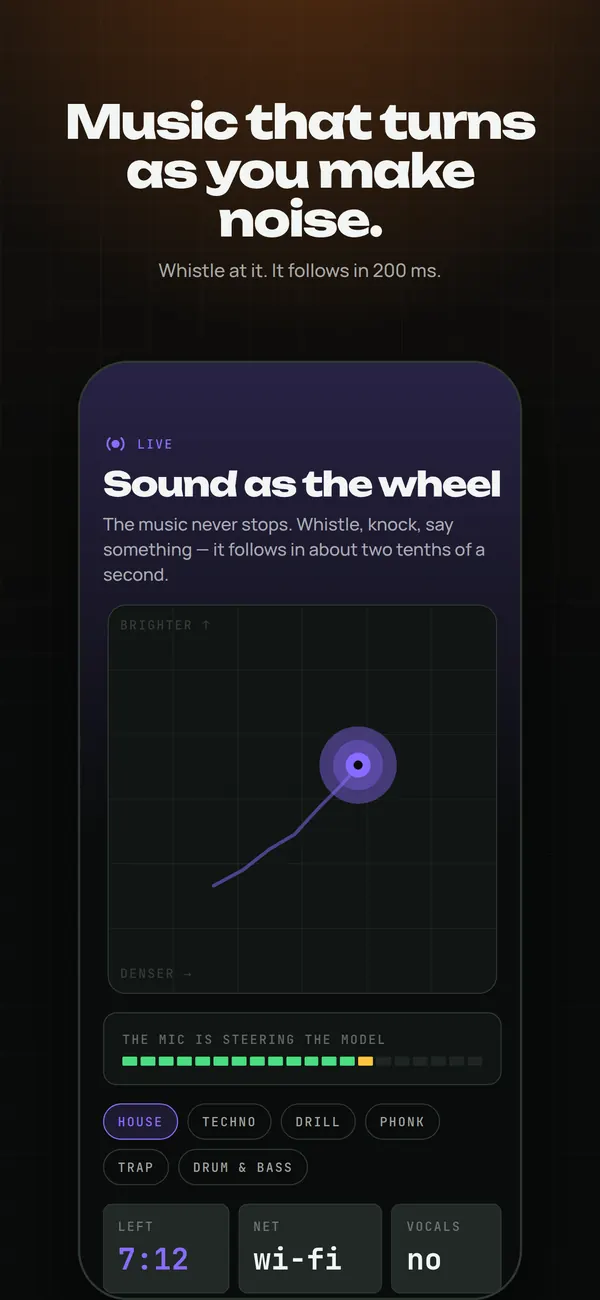
- The first beat plays 200 ms after recording, and the full arrangement is ready in about 2 seconds, on the device, with no server.
- “Presence” is a release gate: a track where the user’s sound falls below 0.5 is never shown; the engine rebuilds it.
- Unit economics before launch: 91% Pro margin, a free user costs about $0.024 over a lifetime; growth comes from shared clips, not paid acquisition.
200 ms
from end of recording to the first beat
≥ 0.5
audibility threshold for the user’s sound
91%
median Pro subscription margin
Problem
AI music generators hand you a track you had no hand in. There is nothing to be proud of and no reason to show it to friends. And competing with Suno on vocal quality is a war lost in advance.
Everyone else makes music from a text prompt. Sample Zero makes it from a sound you made.
Solution
- 01
Capture
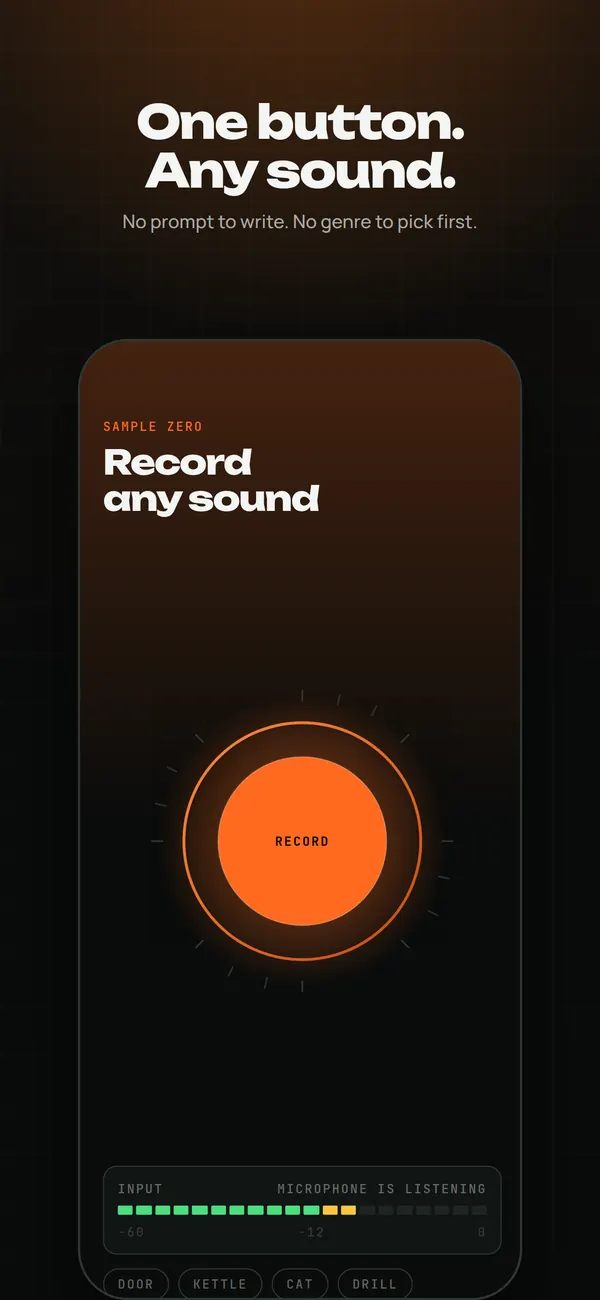
One button. The app keeps half a second of audio from before the tap, stops on silence and checks the quality.
- 02
Analysis
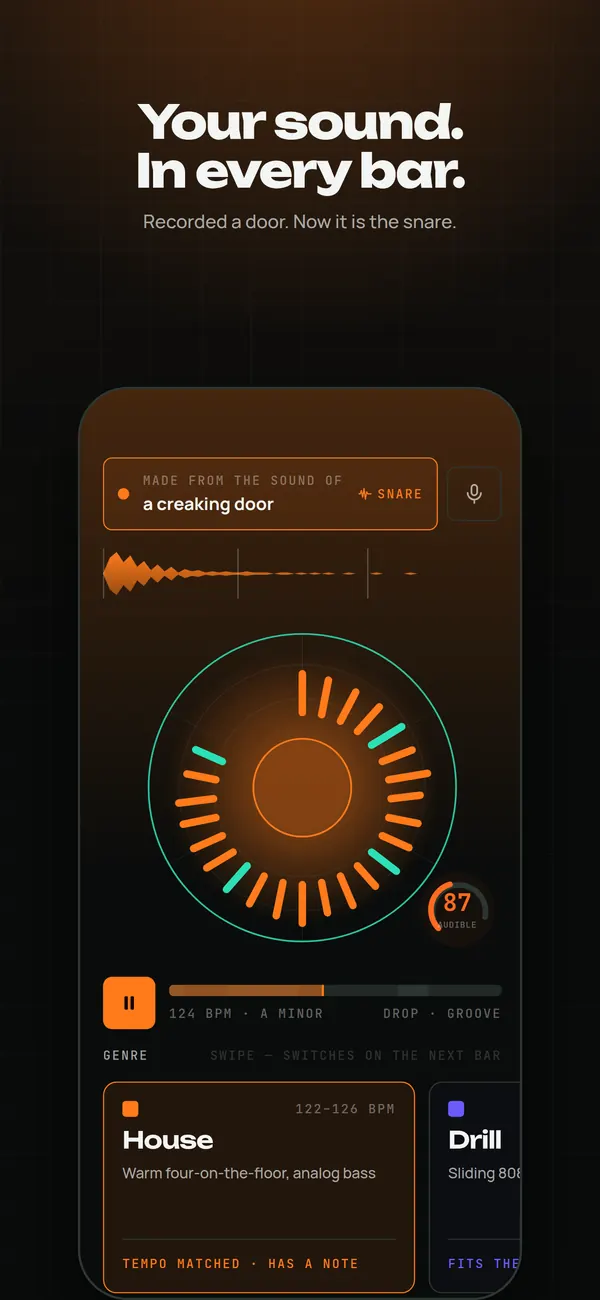
The engine decides what the sound can be in music (kick, snare, hat, bass, lead) and explains why. One tap changes the role.
- 03
Studio
12 genres by swipe, switching on the next bar like a DJ. The AI backing track arrives later and fades into the mix.
- 04
Clip
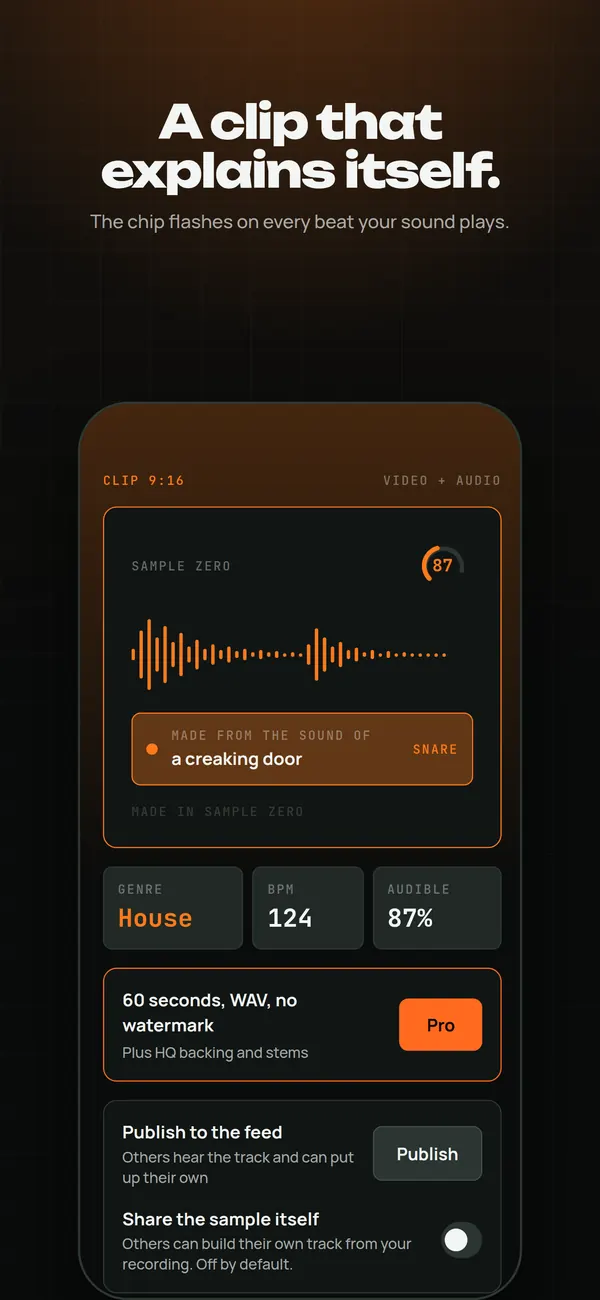
A 9:16 video where the “made from the sound of…” chip flashes on every hit of the sample. The clip explains itself, and that is the growth channel.
Try it
Decisions
- ADR 001
Presence is a release gate, not a metric
Why. The product’s promise is easy to break quietly: the arrangement grows, the backing arrives and the sample drowns. So a track below the threshold is never shown: up to three rebuilds, otherwise an explicit warning. The sample plays in every bar, and tests enforce it.
Rejected: Measuring and showing a number, hoping someone notices the low values.
- ADR 004
Microphone only, no file import
Why. Import would open the door to other people’s tracks and copyright claims. “We only work with sounds you record yourself” is a deliberate choice, not a missing feature.
- ADR 006
A device ID instead of accounts
Why. The whole point is twenty seconds from tap to music, and a sign-up screen would be a wall exactly where the “wow” happens. The cost is written down honestly: reinstalling loses the library, and “Restore purchases” brings the subscription back.
- ADR 005
Live mode gets a single-use token
Why. The AI provider’s key never ships in the app: the server issues a one-minute token.
Economics before launch
| Product | Price | Margin |
|---|---|---|
| Pro, monthly | $8.99 | 91% (median) |
| Pro, yearly | $49.99 | 80% |
| 10 credits | $4.99 | 81% |
| Licensed export | $5.99 | 84% |
A free user costs almost nothing: the on-device engine is free, and a typical free user makes a few AI backings in a lifetime, about $0.024. The model’s main conclusion is unpleasant and useful: paid acquisition does not pay back on these numbers, so growth has to come from clips people share themselves. Launch is English-first and global, because the stores do not pay out to Russian developers.
The North Star is the share of sessions that end in a saved clip (target above 25%) plus average presence above 0.7. Analytics are computed on the device and never leave it, a privacy decision rather than a gap.
How it is built
A monorepo. Its heart is a dependency-free TypeScript sound engine: FFT, pitch detection, onsets, an arranger, a synth and time-stretch. The same code runs in Node, the browser and the phone, which is why the demo above is real. The app is Expo and React Native with Skia; the backend is a Cloudflare Worker with R2 and KV; a router picks AI providers (ACE-Step, Stable Audio, ElevenLabs Music, Lyria) by capability and budget; subscriptions go through RevenueCat.
Status
The code is written, 70 tests pass, and store listings and screenshots are ready in two languages. The app has not yet run on a real phone; that is the next step.
Want more? Switch the reading depth to 30 min.